
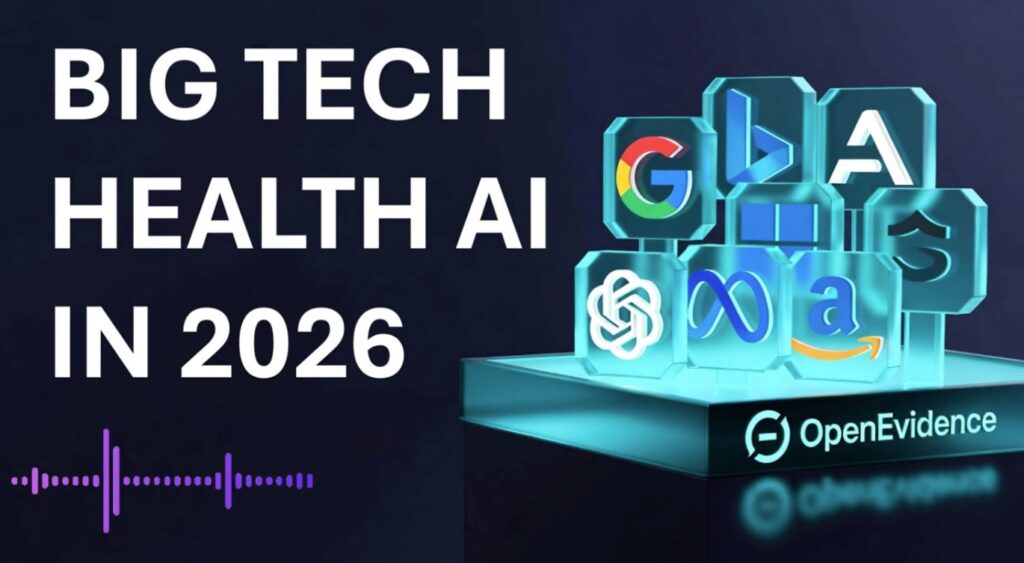
Big Tech Strategies for Healthcare Ai use in 2026
While some specialized tools and vertical integrations show promise, the field is wide open for a player to tackle a genuine grand challenge in frontline medicine, moving beyond medieval frameworks to a model of high-bandwidth, continuous data exchange and real-time patient disease management.
An overview of various companies and their strategies in the Health Ai landscape
- OpenAI is focusing on a consumer and patient moat (1:33). Their ChatGPT Health aims to be a personalized health ally, pulling together fragmented personal data like PDFs, lab results, and wearable data into a single interface to create a digital front door (1:48 – 2:06).
- Anthropic is positioning itself as an enterprise plumbing tool for hospitals (2:29). Their Claude for Healthcare utilizes model context protocols (MCPs) and agentic skills to integrate with clinical registries and interoperability standards (2:34 – 2:47), focusing on automating administrative tasks like prior authorizations and clinical trial protocols (2:53 – 3:00).
- Google is described as having an “uncharacteristically incremental” approach, producing models like Med-Gemini and Med-ASR, and releasing open-source specialized models that understand 3D imaging and medical speech (3:23 – 3:47). The speaker suggests their research often feels like effectively reported incrementalism that borders on marketing rather than solving fundamental clinical paradigms (4:03 – 4:54).
- Microsoft offers ubiquitous tools like Co-pilot in Teams and Outlook in clinical settings (5:12 – 5:16), but these are often seen as misaligned with clinical reality due to a lack of granular control and restrictions on using real patient data (5:19 – 5:42). They also have a secretive research program exploring reasoning models that simulate diagnostic pathways (6:08 – 6:12).
- Amazon is building on its acquisition of One Medical to close the loop between data and delivery of care (6:53 – 6:59). They are moving from generative AI to agentic AI, aiming to not just provide information but also to book appointments and renew prescription scripts through integrating AI agents into a primary care network and pharmacy (7:00 – 7:13).
- Open Evidence is a current outlier, focusing exclusively on clinical evidence synthesis for doctors (7:24 – 7:27). It solves the problem of finding authoritative peer-reviewed answers at the point of care by grounding its retrieval augmented generation (RAG) in top-tier journals (7:29 – 7:48).
- Epic, a major electronic healthcare records (EHR) maker, has entered the ring with Comet, a model trained on 118 million records that attempts to predict clinical trajectories (8:09 – 8:16). However, it faces a “data archaeology problem” due to being trained on over a decade of shifting coding structures (8:19 – 8:27).
- Oracle, which owns Cerner (another big EHR system), possesses a dominant data position but currently lacks a clear functional AI product with proven clinical benefit (8:33 – 8:41).
- The AI scribe market is noted as becoming a commodity, with many companies using frontier models to transcribe consultations, but with little differentiation or significant standalone productivity gain (8:48 – 9:04).
- Meta and X.AI are noted as being missing from the clinical room (9:23 – 9:29), as their business models and philosophies (user engagement, advertising, unfiltered design) are not a natural fit for the highly regulated, safety-critical medical environment (9:32 – 9:50).
- Apple is playing a “longer game” by increasingly incorporating clinical-grade sensors into iPhones and Apple Watches, turning them into potential regulated medical devices (9:57 – 10:12). Their strategy is described as passive longitudinal phenotyping, aiming to “own the door” by continuously collecting validated, encrypted patient data directly on devices (10:15 – 10:29).